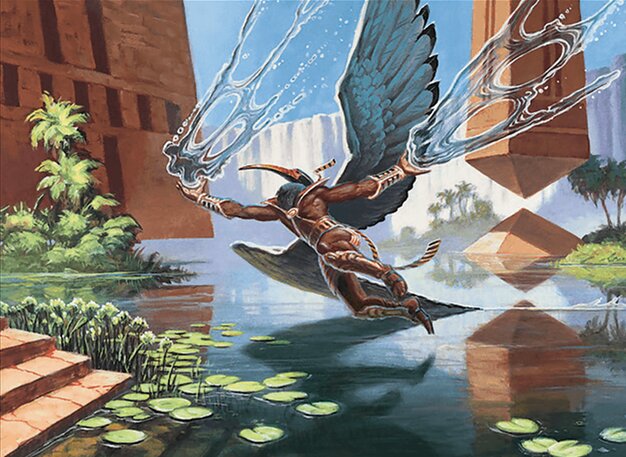
The summer of 2024 will go down in Modern history as “Nadu Summer”—a brief but unforgettable period when a single three-mana legendary bird fundamentally warped the entire format. Nadu, Winged Wisdom didn’t just make waves when it hit Modern Horizons 3; it created a tsunami that swept away the established metagame and left players scrambling to adapt to one of the most oppressive combo decks the format had ever seen.
What made Nadu so devastatingly effective wasn’t immediately obvious from the card’s text. A 3/4 flyer for three mana that draws cards when creatures you control become targets of spells doesn’t sound format-breaking on paper. But when combined with zero-mana equipment and clever synergies, Nadu transformed into a combo engine capable of drawing dozens of cards and winning games as early as turn three.
Understanding the Nadu Engine
The core of every Nadu deck revolved around a deceptively simple interaction. Nadu, Winged Wisdom has a triggered ability that lets you reveal the top card of your library whenever a creature you control becomes the target of a spell or ability. If it’s a land, you put it into play. If it’s nonland, you put it into your hand. This ability can trigger twice each turn for each creature you control.
The key breakthrough came with zero-mana equipment like Shuko and Lightning Greaves. These artifacts could be equipped repeatedly to Nadu or other creatures, triggering the ability over and over again. Each trigger potentially drew a card or ramped a land into play, creating an explosive engine that could chain together for enormous card advantage.
Shuko became the most important piece of the puzzle. This humble equipment from Champions of Kamigawa, originally designed to give creatures +1/+0, suddenly became one of the most feared cards in Modern. Since it costs zero mana to equip, players could target Nadu repeatedly, drawing through huge chunks of their library in a single turn.
The Combo Lines
A typical Nadu turn looked something like this: Cast Nadu on turn three, then immediately start equipping Shuko back and forth between Nadu and any other creature. Each equip triggers Nadu’s ability twice—once when targeting Nadu, once when targeting another creature. Hit lands? Great, now you have more mana. Hit creatures or spells? Even better, now you have more resources to continue the chain.
The most consistent builds ran creatures like Ornithopter and Phyrexian Walker as additional targets for equipment. These zero-mana creatures provided extra bodies to trigger Nadu while costing nothing to deploy. Some lists even included Elvish Reclaimer to fetch specific lands and provide another cheap creature body.
The Optimal Nadu Build
By the peak of Nadu Summer, the deck had evolved into a frighteningly consistent combo machine. The most successful versions combined the Nadu engine with additional card selection and protection to ensure the combo could go off reliably.
Nadu Combo (Modern)
| Creatures (18) 4 Nadu, Winged Wisdom 4 Ornithopter 4 Phyrexian Walker 4 Elvish Reclaimer 2 Endurance Spells (18) 4 Mishra’s Bauble 4 Urza’s Bauble 4 Once Upon a Time 4 Summoner’s Pact 2 Chord of Calling Equipment (8) 4 Shuko 4 Lightning Greaves | Lands (22) 4 Windswept Heath 4 Misty Rainforest 2 Forest 2 Island 1 Breeding Pool 1 Dryad Arbor 8 other fetchlands and basics Sideboard (15) 3 Force of Negation 4 Leyline of Sanctity 4 Veil of Summer 4 other situational cards |
The deck’s game plan was straightforward but devastatingly effective. Mulligan aggressively for hands containing Nadu plus equipment, then execute the combo as quickly as possible. Once Upon a Time provided additional consistency by letting players find missing pieces, while Summoner’s Pact could tutor up Nadu when needed.
Why Nadu Was So Dominant
What made Nadu truly oppressive wasn’t just its combo potential—it was how resilient and fast the combo was. Unlike many combo decks that fold to a single piece of interaction, Nadu could rebuild quickly thanks to its card draw engine. Even if the first Nadu got removed, the deck often drew enough cards to find another copy plus protection.
The speed was equally problematic. Turn three wins weren’t uncommon, and turn four kills were routine. This put enormous pressure on the rest of the format to either go faster or pack specific hate cards. Neither option was particularly appealing for most archetypes.
The Metagame Response
Modern players tried everything to combat Nadu. Orcish Bowmasters saw increased play as a way to punish the card draw, but Nadu decks simply adapted by playing around the Orc or using it as an additional combo enabler. Chalice of the Void on zero could shut down the equipment, but Nadu decks packed Force of Vigor and other answers.
Some players turned to prison strategies with Trinisphere and Blood Moon, while others tried to go even faster with hyper-aggressive strategies. But Nadu’s combination of speed, consistency, and resilience made it incredibly difficult to hate out effectively. The deck maintained dominant win rates across all levels of play, from local tournaments to professional events.
Traditional control decks struggled the most. Counterspell could stop Nadu temporarily, but the card advantage engine made it nearly impossible to keep up with resources. Removal spells felt ineffective against a deck that could draw twenty cards in response to a single Lightning Bolt.
The Community Impact
Nadu Summer lasted approximately three months, but its impact on the Modern community was immediate and severe. Tournament attendance dropped as players grew frustrated with the homogenized metagame. Local game stores reported decreased interest in Modern events, with many players switching to other formats or taking breaks entirely.
The financial impact was significant too. Shuko spiked from bulk rare status to over $20 per copy overnight. Nadu, Winged Wisdom itself commanded premium prices despite being from a recent set. Many players felt forced to buy into the deck or accept poor tournament performance.
The Ban and Aftermath
Wizards of the Coast acted relatively quickly by Modern standards, banning Nadu, Winged Wisdom in August 2024 after roughly three months of dominance. The ban announcement acknowledged the card’s oppressive impact on the format’s diversity and the negative play experience it created.
Interestingly, Wizards chose to ban Nadu itself rather than the enablers like Shuko. This decision preserved other fringe strategies while eliminating the specific problem card. The ban was largely welcomed by the community, though some players who had invested heavily in the deck expressed frustration about the financial losses.
Post-ban Modern saw an immediate diversification of strategies. Decks like Murktide Regent, Living End, and various tribal strategies returned to prominence. The format’s health improved dramatically within weeks of the ban taking effect.
Lessons from Nadu Summer
Nadu’s brief reign taught the Modern community several important lessons about combo design and format health. First, it highlighted how seemingly innocuous cards can become format-warping when combined with the right enablers. Nadu, Winged Wisdom looked reasonable in isolation but became oppressive when paired with zero-mana equipment.
The episode also demonstrated the importance of format diversity. When a single strategy becomes too dominant, it creates a negative feedback loop that drives players away from the format. Nadu’s success rate and play patterns made tournaments less enjoyable for everyone involved.
Design Philosophy Questions
Nadu raised questions about Modern Horizons design philosophy. Should cards printed directly into Modern be more conservatively costed? How extensively should new cards be tested against the format’s deep card pool? These discussions continue to influence how the community views supplemental sets.
The speed of the Nadu combo also reignited debates about Modern’s turn-four rule—the unofficial guideline that combos shouldn’t consistently win before turn four. Nadu routinely violated this principle while providing enough card advantage to rebuild from disruption.
Nadu’s Legacy
Today, Nadu Summer serves as a cautionary tale about the dangers of underestimating synergy-based combo decks. The card’s brief dominance reshaped how players evaluate new combo potential and influenced subsequent Modern design decisions.
For newer players, studying the Nadu phenomenon offers valuable insights into how Modern’s deep card pool can create unexpected interactions. It also demonstrates why the format maintains a banned list and how quickly metagames can shift when powerful new tools become available.
The Nadu story isn’t just about one overpowered card—it’s about the delicate balance that keeps competitive Magic formats healthy and enjoyable. Sometimes that balance requires decisive action, even when it means acknowledging that a recently printed mythic rare was simply too powerful for the format it was designed to enter.
Nadu Summer may be over, but its lessons continue to influence Modern today. Every new combo piece gets evaluated through the lens of Nadu’s dominance, and players remain vigilant for the next engine that might threaten format diversity. In a strange way, Nadu’s ban made Modern stronger by reminding everyone what happens when that balance gets disrupted.